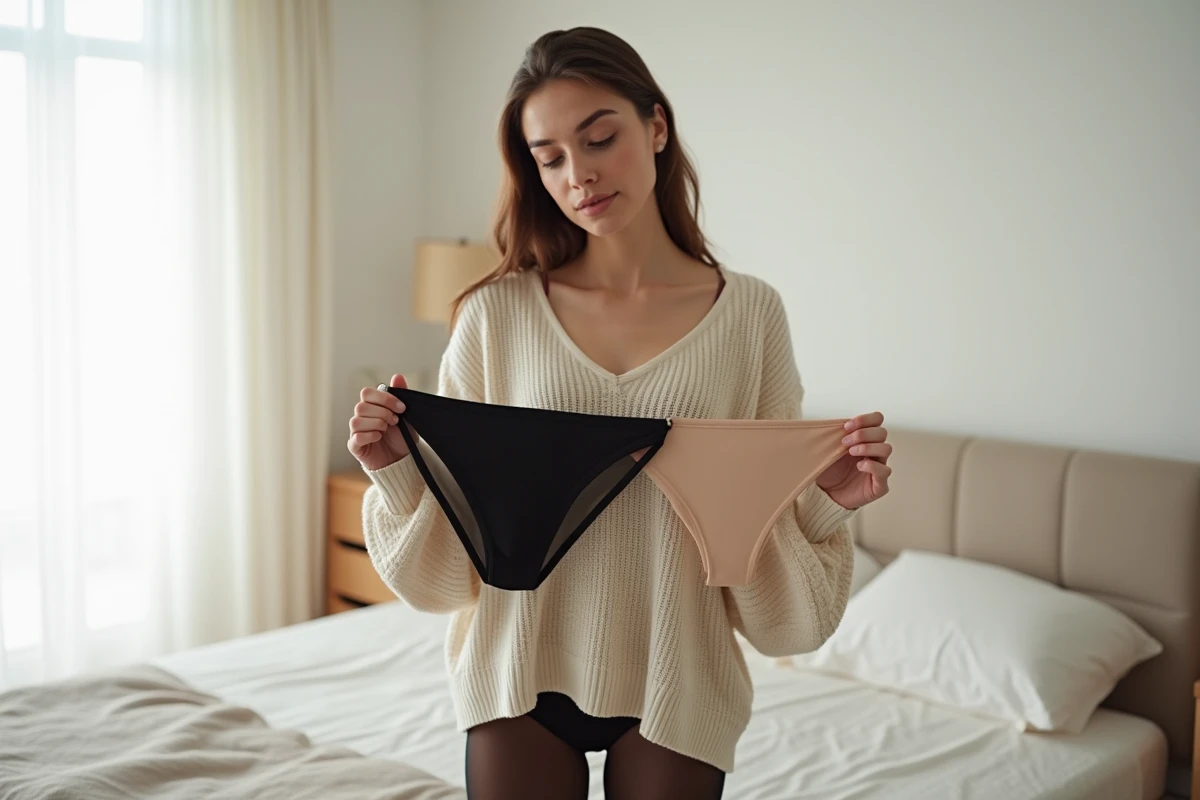
The question regularly arises in locker rooms, on forums, and in fitting rooms: should you wear underwear under tights? The topic touches on comfort, intimate hygiene, and dressing habits, without a clear consensus emerging.
Breathability and intimate area: what the material of the tights really changes
Most online discussions pit two camps against each other (with or without underwear) without asking the right question. The real criterion is not the presence of underwear, but the breathability of the entire garment worn over the intimate area.
A classic pair of tights made from synthetic fibers (polyamide, elastane) creates a warm and humid environment around the groin. Wearing tight tights directly on the skin, without a breathable intermediate layer, can promote skin irritation and vulvovaginal infections. Medical recommendations for preventing vaginal infections favor cotton or breathable fabrics and emphasize quick changes after sweating.
The question of wearing underwear under tights largely depends on the fabric. Tights with an integrated cotton gusset change the equation: this piece of fabric, sewn into the crotch, partially fulfills the role of underwear. In contrast, a thin pair of tights without a gusset leaves the skin in direct contact with nylon, which offers no absorption.

Cotton gusset of the tights: an integrated underwear or a partial substitute?
The gusset, this small piece of fabric at the crotch, is often presented as proof that tights can be worn without underwear. This interpretation is simplistic.
The gusset absorbs some sweat, but its surface remains limited. It does not cover the entire area that underwear would cover. Over a long day, in mild weather or during physical activity, its absorption capacity quickly reaches its limits.
Moreover, not all tights have a cotton gusset. Entry-level models sometimes use a synthetic gusset or may not have one at all. Checking the composition of this piece before purchase is a useful reflex.
- Tights with a 100% cotton gusset: offer minimal protection for short and low-activity days
- Tights with a synthetic gusset: provide no benefit in terms of breathability, a cotton underwear remains preferable
- Tights without a gusset: wearing cotton underwear is essential to limit friction and moisture
Opaque tights, thin tights, compression tights: distinct uses
The type of tights significantly alters the response. An opaque pair of tights with a high fabric density compresses more and retains more heat than a thin transparent pair. The thicker and tighter the tights, the less ventilation there is.
Compression tights and medical compression
High-compression tights, prescribed for venous disorders, are not equivalent to fashion tights. Their use depends on the level of compression and the medical indication. These devices are regulated as health products, and the wearing recommendations (with or without underwear) vary according to the manufacturer and prescription.
Mixing advice applicable to fashion tights with that of a medical compression device makes no sense. Feedback on this point varies, and it is best to follow the prescriber’s advice.
Thin and transparent tights
With very thin tights, the question of style also comes into play. Visible panty lines under transparent tights pose an aesthetic problem that many seek to resolve. Thongs or seamless underwear limit this effect, but at the cost of reduced coverage.
Daily hygiene: the gestures that matter more than the choice of underwear or not
Focusing the debate on the presence of underwear distracts from what really matters in terms of intimate hygiene. The decisive factors are the duration of wear, the material in contact with the skin, and the frequency of washing.
- Change tights every day and wash them after each use, regardless of the choice made
- Prefer cotton underwear if the tights are worn for more than eight hours straight
- Avoid layering two synthetic layers (polyester underwear + nylon tights), as this traps moisture without offering any benefit
- In case of significant sweating (transport, prolonged walking), plan for a change
The combination of two non-breathable synthetic layers is the worst scenario for the intimate area. Cotton underwear under synthetic tights creates an absorbent barrier. Synthetic underwear under the same tights only adds a waterproof layer.
Comfort and support: the often-overlooked role of underwear under tights
Beyond hygiene, physical comfort varies according to body shapes. Some people find that wearing tights alone slips more at the waist, especially if the elastic is soft. Wearing underwear over (yes, over) the tights can provide additional support and prevent the tights from rolling down.
Wearing underwear over the tights improves support without creating a visible line under a skirt or dress. This technique, common among dancers, addresses both the slipping issue and the problem of visible marks.
The final choice remains personal and depends on the tights worn, the duration, the planned activity, and each person’s sensitivity. No option is universally better than the other. What emerges from hygiene recommendations is that the material in direct contact with the skin takes precedence over the question of the number of layers.