
Writing a letter to your son means choosing not only what to say, but also what to leave unsaid. Day-to-day exchanges between parents and teenagers are often brief and practical, focused on logistics. A qualitative study published in 2026 highlights that a teenager’s words do not always reflect what a parent believes to be a close relationship. A handwritten letter offers a different kind of space, as long as it does not become a lecture.
What can help you write sincere words without imposing an emotion, an expectation, or a role on the person receiving them?
Writing a letter to your son: what changes when you don’t expect a reply
Most examples of letters from parents available online follow the same pattern: a declaration of love, a reminder of values, and a vision of the future. This format raises an issue that is rarely addressed. It puts the son in the position of having to receive, agree, or even say thank you.
A study of personal letter archives, published in 2025, shows that a saved letter takes on a different meaning when it is reread decades later, in light of family history and the reader’s adult perspective. This changes the picture: a letter with a date and a clear context will be read differently in the future.
Writing without expecting a reply means accepting that your son might put the letter in a drawer, reread it at thirty, or never read it again. Writing a moving letter to your son feels more sincere when it carries no implicit demand for reciprocation.
The gesture matters as much as the content. A brief note rooted in a specific moment—a shared memory or a concrete observation—often means more than a long, abstract declaration.
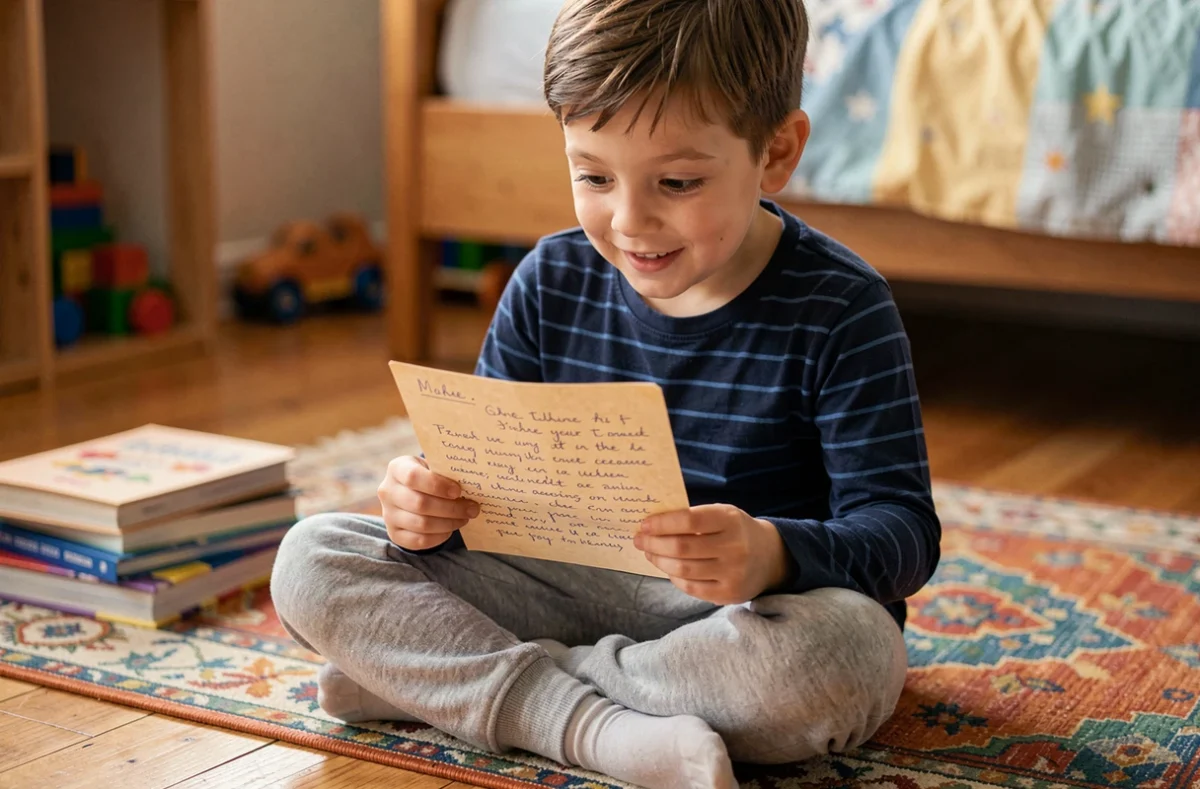
Writing to your son at different ages: a guide to tone and common pitfalls
The recipient’s age changes the impact of every word. A six-year-old does not read like a teenager in conflict or an adult who has just become a father. The table below compares suitable tones for each stage and common pitfalls to avoid.
| Stage of life | Suitable tone | Common pitfall |
|---|---|---|
| Childhood (3-10 years) | A concrete story, an anecdote, simple humor | Projecting a future the child cannot understand |
| Adolescence (11-17 years) | A personal account without a moral, acknowledging what he is going through | Unsolicited advice disguised as a love letter |
| Young adulthood (18-25 years) | An equal-to-equal conversation, sharing a personal doubt or regret | Nostalgia that casts your son as a child again |
| Son becomes a parent | Sharing your own experience as a parent, with humility | Implicit comparisons between generations |
The gap is most pronounced during adolescence. Everyday exchanges are often brief and practical, and parents may overestimate the quality of their relationship. A letter cannot make up for a lack of dialogue, but it can offer a first opening when direct conversation feels difficult.
Adjust the length to the occasion
A three-line message tucked into a travel bag before a summer camp departure can mean as much as a two-page letter for a milestone birthday. A letter works as a small gesture of connection woven into everyday routines, not as a solemn event.
Writing to a son during a period of distance or conflict: how to avoid imposing
This is the most delicate situation, and one that online examples tend to avoid. When a relationship is going through a crisis, a breakdown in communication, or simply a natural period of distance, a parent’s instinct is to fill the letter with explanations, justifications, or requests to reconcile.
A different approach shows greater respect for your son. Here are some principles for writing without imposing:
- Name the situation without judging it: “I know things are complicated between us right now” is better than interpreting how your son feels
- Avoid assigning him an emotion: “You must be feeling…” or “I know you’re angry with me” are projections, not listening
- Leave the door open without making a veiled ultimatum: “If you ever want to talk, I’ll be here” rather than “I’m waiting to hear from you”
- Date the letter and give it context: specific details (the place, the season, what was happening that day) ground the message in reality rather than sentimental abstraction
A letter that shows you are listening rather than offering advice respects your son’s autonomy. It does not try to resolve the conflict in writing. It lets him know you are there, without conditions.

Sincere words for your son: what remains when you strip away the excess
Stock phrases (“I’ll always be proud of you,” “You’re the best thing that ever happened to me”) aren’t untrue. They’re just overused. Your son has read them on birthday cards, in social media posts, and in quotes shared thousands of times.
One specific memory is worth ten general declarations. “I remember the day you fixed your sister’s bike without being asked” says more about a parent’s pride than “I’m proud of the man you’re becoming.”
What a letter can contain that will last
Three elements give a letter lasting value:
- A dated fact your son may not know (what you felt when he was born, a detail from his first day of school, a family anecdote passed down orally)
- An admission of your own imperfections, without dramatizing them, showing that your relationship does not require you to be perfect
- A sentence that acknowledges your son as he is in this moment, not as you would like him to be
Recognizing your son as he is, not as you imagine him to be, is the most difficult and enduring gesture in a parent’s letter. Every word written with this intention becomes a trace of your relationship that time does not diminish, but instead sheds new light on with every rereading.