
The residual water in the boiler of an Italian coffee maker is not a malfunction. It is a direct consequence of the thermodynamic principle that governs extraction in a moka pot: steam pushes the liquid through the filter, but the pressure drops before the reservoir is completely emptied. Understanding this mechanism allows one to distinguish between normal residue and a sign of actual wear.
Residual Pressure and Steam Threshold in the Moka Boiler
The Italian coffee maker operates under pressure. The water heated in the lower chamber generates steam that exerts pressure on the surface of the liquid, forcing it to rise through the funnel and filter to the upper part.
Read also : What is the best time for a safari in Tanzania?
When the water level drops below the funnel entrance, steam escapes directly without pushing any liquid. This is the characteristic hissing that signals the end of extraction. At this stage, there is always a layer of water below the level of the funnel, and this is physically inevitable.
The height of this layer depends on the geometry of the boiler and the position of the funnel. On a classic aluminum Bialetti, the conical bottom retains a few milliliters that the steam can no longer reach. We observe this phenomenon on all models, whether new or old, aluminum or stainless steel.
Related reading : How to access your university email in France?
Cutting the heat too early increases the volume of residual water. If the heat source is removed before the pressure has had time to push the water up to the funnel threshold, more liquid stagnates.
Conversely, keeping the heat on too long after the hissing does not empty the reservoir but overheats the steam and burns the already extracted coffee. This phenomenon is detailed on the Goûts et Passions website, which discusses the technical causes of residual water.

Clogged Filter and Too Fine Grind: When Residual Water Becomes Abnormal
A significantly higher volume of residual water indicates a flow problem. The distinction is simple: a few milliliters at the bottom of the boiler are expected, but a third of the reservoir still full after extraction indicates excessive resistance in the circuit.
The most common cause is a grind that is too fine. When the coffee is ground finer than the grain size intended for a moka (close to espresso), the particles clog the metal filter. The steam can no longer push the water through this compacted mass, and the pressure dissipates through the safety valve or the side seals before the extraction is complete.
Diagnosing a Partially Clogged Filter
If you observe an abnormally long extraction time (the coffee takes much longer to rise than usual), the filter is likely clogged. Coffee residues accumulate in the micro-perforations of the filter and in the upper grid, gradually reducing the flow.
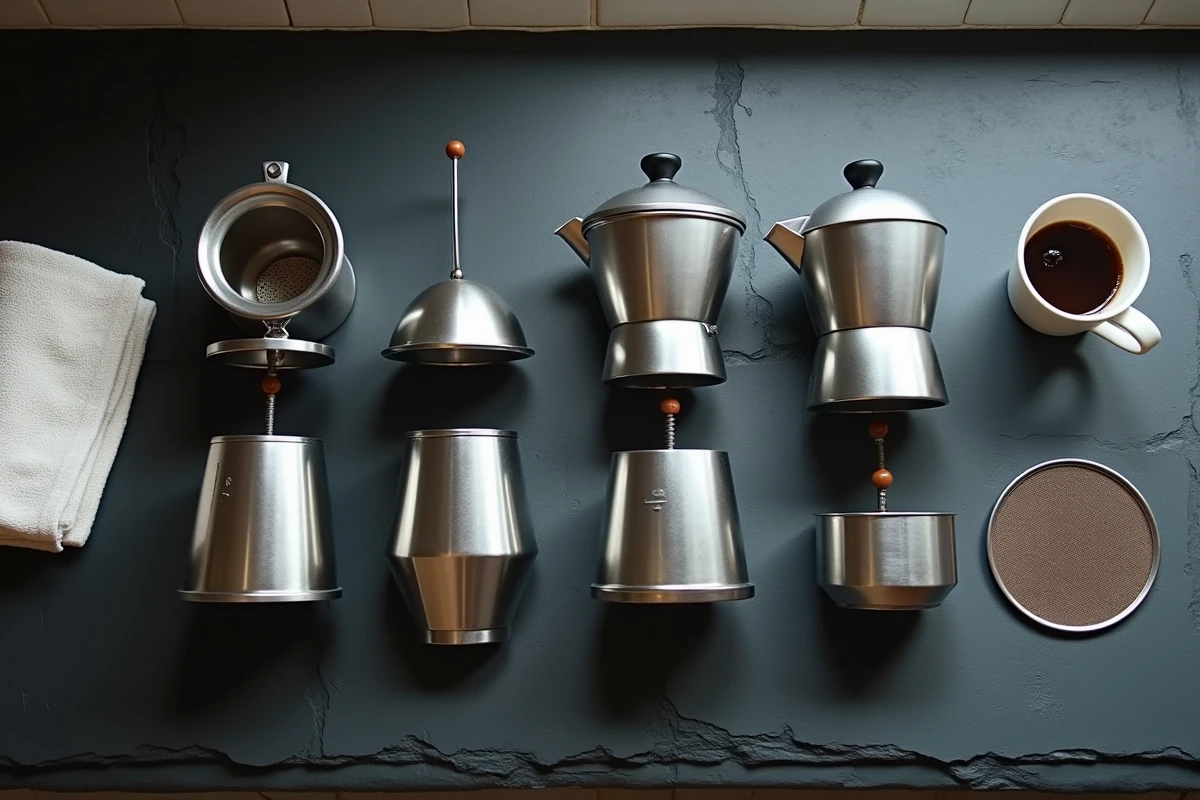
- Disassemble the funnel filter and examine the perforations against the light: holes clogged with brownish deposits confirm the obstruction
- Check the filter holder grid located under the seal of the upper part, often overlooked during daily cleaning
- Soak the metal parts in hot water without detergent, then unclog the perforations with a fine needle
We recommend a complete cleaning of the filter and grid at least once a week for daily use. Simply rinsing with running water is not enough to dislodge the coffee oils that polymerize over time.
Safety Valve and Filling Level: Two Related Parameters
The safety valve, located on the wall of the boiler, is not just a protective device. It also sets the maximum water filling level. Filling above this valve alters the volume of the steam chamber and disrupts the pressure cycle.
With too little space for steam, the pressure rises more slowly and irregularly. Extraction starts late, occurs in fits and starts, and the volume of residual water at the end of the cycle increases. This is not a problem with the power of the heat source, but an imbalance between the volume of water and the volume of steam.
Clogged or Stuck Valve
On Italian coffee makers used for several years, the safety valve can become stuck in the closed position due to limescale deposits. In this case, the overpressure has no safety valve, which poses a real risk. If your valve does not move at all when you gently push it with a toothpick, replace it.
A stuck valve does not directly cause residual water, but it masks an excess of pressure that can damage the O-ring. And it is the wear of the O-ring that, in the long run, generates side leaks and a loss of pressure preventing the water from rising properly.
Worn O-Ring: The Real Culprit of Incomplete Extractions
The rubber (or silicone, depending on the models) O-ring that ensures the seal between the boiler and the upper part is the main wear part of an Italian coffee maker. When it hardens, cracks, or deforms, pressure escapes through the junction instead of pushing the water up.
- A good condition O-ring is flexible, uniform, and fits perfectly into the groove without visible gaps
- A worn O-ring shows signs of deformation, cracks, or does not return to its original shape after compression
- On aluminum Bialetti models, the original O-ring can be easily replaced with kits that include the O-ring and filter grid
Replacing the O-ring restores extraction pressure and significantly reduces the volume of residual water. This is the first intervention to consider on a coffee maker that leaves too much water in the reservoir, before suspecting a more complex problem.
The frequency of replacement depends on the intensity of use. For daily use, we recommend changing the O-ring as soon as screwing the coffee maker no longer produces firm resistance, a sign that the rubber no longer compresses properly.
The water at the bottom of your Italian coffee maker tells the condition of three components: the filter, the O-ring, and the valve. A few milliliters are normal and inherent to pressure operation. Beyond that, check the grind, clean the filter thoroughly, and inspect the O-ring. These simple actions are sufficient in the vast majority of cases to achieve a complete extraction and coffee that meets the standards of what the moka can produce.