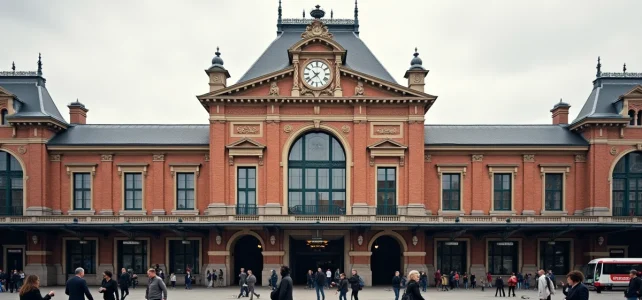
You arrive in Lille by train and your ticket indicates a station you don’t know. Lille Flandres or Lille Europe, the name changes, and so does the platform. These two stations, separated by a few hundred meters, do not serve the same lines, do not operate in the same way, and do not offer you the same flexibility in case of unforeseen events.
Ticket, connection, and flexibility: the real criteria for choosing your station in Lille
Most guides compare Lille Flandres and Lille Europe based on the destination. Paris is Flandres. London is Europe. This shortcut works in broad terms, but it masks what really matters when booking or modifying a journey.
You may also like : How to Choose a Free and Effective Messaging Platform for Your Daily Needs
The first useful reflex is to look at the type of ticket you purchased. A TGV INOUI ticket to Paris departs from Lille Flandres. A OUIGO ticket on the same route may depart from Lille Europe, depending on the time slot. If you buy without checking the station, you risk finding yourself on the wrong side of the boulevard.
The second criterion, often overlooked, concerns the connection. Connecting a regional TER and an Eurostar means moving from one station to the other. The walking distance between the two takes about ten minutes at a normal pace. It’s doable, but tight if your first train is delayed. A detailed comparison on the Lille Flandres and Lille Europe station allows for better anticipation of these connections based on your itinerary.
You may also like : How to choose the best gym for your child?
The third criterion is schedule flexibility. Lille Europe concentrates its international trains on certain time slots, which limits your options if you miss a departure. Lille Flandres offers a higher frequency to Paris and regional cities, with trains every half hour during peak times.

Lille Flandres: terminal station for TER and TGV to Paris
Lille Flandres is the historic station, right in the city center. Its facade resembles that of the Gare du Nord in Paris, which is no coincidence: it is a partial replica. Beyond the architectural anecdote, its operation as a terminal station has practical consequences.
All TER trains from Hauts-de-France depart from Lille Flandres. If you are going to Arras, Douai, Valenciennes, Lens, or Dunkirk by regional train, this is where you need to be. The TGV INOUI trains to Paris-Nord also pass through Flandres, with a travel time of around one hour.
Being a terminal station means that the train stops there. No crossing of tracks, no confusion about the direction of travel. For travelers with luggage or accompanied by children, this is a detail that simplifies boarding.
Access and urban transport from Flandres
The metro station Gare Lille Flandres is served by both lines of the automatic Ilevia metro. You are also just a few minutes’ walk from the Grand’Place. If you arrive by car, parking in the immediate vicinity remains complicated, as in any city center.
Lille Europe: transit station for Eurostar and some TGVs
Lille Europe was opened in 1994 as part of the Euralille project. Its initial role: to accommodate high-speed trains passing through the metropolis without terminating, notably the Eurostar to London and Thalys (now integrated into Eurostar) to Brussels and Amsterdam.
It is the only Lille station for international trains. If your ticket mentions London St Pancras or Brussels-Midi, you must go to Lille Europe. No exceptions.
Some domestic TGVs also stop at Lille Europe, particularly those connecting southern France (Lyon, Marseille, Montpellier) without passing through Paris. OUIGO trains may also stop there depending on the day.
The trap of concentrated schedules
Eurostar trains do not run every hour from Lille. The service is concentrated on a few time slots each day. Missing an international train at Lille Europe can mean several hours of waiting, or even a postponement to the next day during off-peak times. Allow at least thirty minutes before departure, especially since security and passport checks add time to boarding.

Moving from one station to another in Lille: real-time and connection options
The two stations are close, but not connected by an internal corridor. You need to exit and walk. Here’s what you need to know for a successful connection:
- On foot, count about ten minutes between the halls of the two stations. The route passes through the Euralille shopping center, which can slow you down if you don’t know the way.
- The metro connects Gare Lille Flandres to Gare Lille Europe in one stop on line 2. The journey takes two minutes, but the time to access the platforms and wait for the metro easily adds five to eight minutes.
- In case of reduced mobility or with bulky luggage, the metro is more comfortable than walking, especially in bad weather. Both stations are accessible.
If your connection between a TER at Flandres and an Eurostar at Europe is less than twenty minutes, the risk of missing it becomes real. Prefer a gap of at least thirty minutes between your two trains, especially if the first is a TER likely to be delayed.
Check your departure station before booking
On booking platforms like SNCF Connect or Trainline, the departure station is indicated by its full name: “Lille Flandres” or “Lille Europe”. Do not rely on just the word “Lille”.
Here are a few quick references:
- TER Hauts-de-France: always Lille Flandres.
- TGV INOUI Paris-Lille: generally Lille Flandres.
- Eurostar (London, Brussels, Amsterdam): always Lille Europe.
- Intercity TGVs (Lyon, Marseille, Strasbourg): often Lille Europe, but check each train.
- OUIGO: variable depending on the time slot, the station changes from day to day on certain lines.
The choice between the two Lille stations does not depend solely on your final destination. Your type of ticket, your need for a connection, and your tolerance for schedule risk weigh equally in the decision. Checking the exact station at booking takes a few seconds and can save you a dash between two halls that are not directly connected.